An update from Liz Slade

I’m grateful to those who suggested this new feature – I’m often aware of how easy it is to be busy without taking a moment to reflect and share what I’m up to. So I’m glad to share this taster of the last couple of months.
Our October EC meeting at Leicester Great Meeting was excellent; I am grateful for the thoughtful and collaborative EC members and their impressive array of professional expertise. It’s been wonderful holding our EC meetings at chapels around the country, having a chance to meet congregations, be in their varied buildings, and get a close-up sense of the life of a chapel.
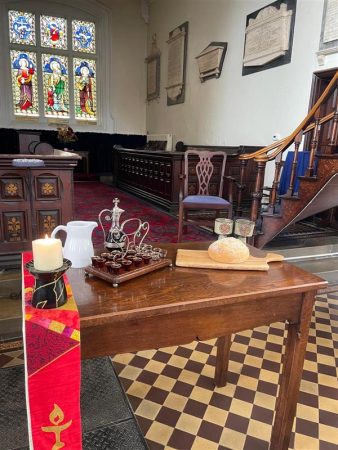
Aside from the meeting, a highlight was the Harvest Communion that Arek hosted as an optional extra after the main Sunday Service. I felt a bit courageous joining, as I can count on one hand the number of communions I’ve taken part in, but Arek’s explanation made me know I was welcome to receive it. It was particularly moving to be using the early 20th century communion set, gifted to Leicester Great Meeting when the nearby Narberth Road congregation closed in the 70s; it was the one used by Gertrude von Petzold, our first female minister, and it was absolutely exquisite. I’m normally one for function over form, but the beauty of the tiny individual glasses and their case definitely added to the ceremony. In these times of deep change societally and in our movement, it was moving to take part in a ritual that has been happening for centuries using physical objects handed lovingly from a congregation at the end of its life now used in Great Meeting’s lively community.
These ideas of endings and baton passing were fresh in my mind as I had attended the Decelerator Assembly in Birmingham a few days before; a conference of 100 people from across the charity sector and civil society all holding questions of how we manage the inevitable endings of projects and organisations well when they come. I was grateful that Kieren Mardle-Moss of the Belper congregation and Midlands Unitarian Association, and Karen Gartside of Torbay also attended. We are the first faith group to be working with the Decelerator but of course recognise that changing patterns of gathering are not unique to our denomination. I’m conscious that there is much we are learning that can benefit our own movement, but also is hugely valuable across the whole faith sector. Last weekend we began the ‘There is a season’ series of workshops, led by Lizzie Kingston Harrison and co-hosted with the Decelerator for Unitarians ready to lean in to this learning. One thing the Decelerator team highlight with secular charities they work with is the need for ritual and ceremony to mark changes well, not just reaching for professional legal and financial advice. That door is already open with us of course, so the Decelerator team are learning with us.
We are also learning a lot through the innovation fund.
it’s been wonderful to celebrate the grants being awarded – so far these have been the smaller (<£5k) Development Grants that enable a pilot project or research that form groundwork for a larger scale piece of work. These have been brilliantly varied, and I admire everyone who has taken the plunge to make an application.
As part of the support we are offering to help get people ready to make an application, Nick, our Programme Manager, has now hosted over 130 Unitarians in small workshops using the Three Horizons framework as a model of imagining the future we want and how we might get there. The purpose of these is primarily in service of those local leaders taking part, helping them hone their thinking, but as Nick starts to synthesise the insights from these workshops we are seeing fascinating trends that feel valuable in helping us know ourselves better as a movement. Again, many of these trends are not unique to a Unitarian context.
Beyond the Unitarian sphere, I was delighted to be invited onto the Ratio Talks podcast, hosted by Michael Little. The jumping off point was Robin Dunbar’s 2022 book ‘How Religion Evolved: and why it endures’ but we covered a lot of ground! The series starts with an interview with Chine McDonald, Director of the Christian think tank, Theos.
I took a week off in September to co-lead a pilgrimage in Derbyshire based on Jane Austen’s Pride & Prejudice. This was picking up the thread of a project I helped launch in 2018 with Vanessa Zoltan, host of the Harry Potter and the Sacred Text podcast – pilgrimages that use secularised versions of sacred reading practices to read beloved novels in community, while walking in landscapes resonant with their themes or authors. 21 pilgrims came on this trip (all happened to be women from America), which I co-led with Elizabeth Oldfield of the Sacred podcast and Sarah Stewart Holland of Pantsuit Politics. There is something magic about seeing the group shift from strangers to lifelong friends through letting beautiful landscapes and powerful art speak to their own lives.
In September attended an event at Conway Hall (former home of the South Place Ethical Society, an early 20th century offshoot of a Unitarian congregation) a few weeks ago that was hosted by collaborators from the Hard Art collective – who also collaborated with Doncaster Unitarians’ brilliant ArtBomb festival in August. At Conway Hall, ‘The Fate of Britain’, explored ideas of Britishness (this was at the time of ‘peak flag’), of community, of finding commonality across division. I was delighted to bump into a few Unitarians there – and also that the role of the spiritual was not overlooked. One of the first speakers of the day, the writer and spiritual director Vanessa Chamberlin, named her influences of Walter Breuggeman, Martin Buber, and the Jewish prophets. I heard many people name later how much they appreciated the permission to engage in these ideas rather than exploring social change through a purely secular lens.
I think often of the tensions our movement is inhabiting. That it’s easy in a tiny congregation to feel that we are trying to do something that people are no longer interested in, but that it’s simultaneously true that the appetite for communities and practices of meaning, depth, and belonging is greater than ever. Our free and inquiring religion means we are primed to adapt to the needs around us without letting go of our core ethos, and I’m glad to be alongside everyone who is bravely entering into this work that has no right answers!