June’s Letter from Liz
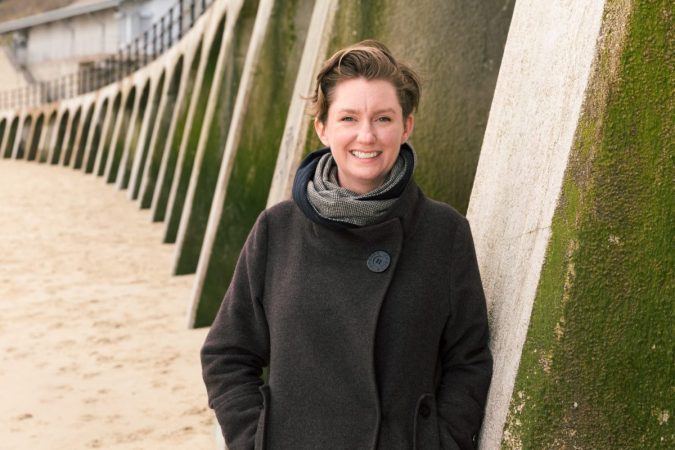
Each month, we publish a letter from Liz Slade, the chief officer for the General Assembly. This is Liz’s letter for June 2026.
June is Pride month.
Which makes me think – bear with me – of 1662.
This was the year that our dissenting forebears lost their right to worship freely if they didn’t adopt the Church of England’s rules. Their conscience told them that the divine couldn’t be codified, and they accepted their loss of livelihood, loss of rights, and another 150 years of persecution before Unitarians had equal rights under the law.
Their freedoms to express themselves in line with what they knew to be true, beautiful, and lifegiving were lost as the law cut bold lines into what had previously been free.
I don’t know the full history of marriage law in Britain, but at some point a law was made that said only men could marry women. Those who loved beyond those lines lost their rights to live freely.
I love learning the stories of the ‘Unitarian spinsters’ of years gone by – women who lived with ‘companions’, and sometimes were buried alongside them. Love found a way, even if the law didn’t recognise it.
Unitarians are rightly proud of the role our denomination played (alongside Quaker and Liberal Jewish colleagues) over a dozen years ago to ensure the right of equal marriage in religious buildings – and since then over 100 of our churches, chapels and meeting houses have registered to conduct same-sex weddings.
One of those is Gellionnen Chapel, where I was delighted to visit, along with our Executive Committee during the weekend of Pontardawe Pride earlier this month. The congregation generously hosted our meeting in their Graig Community Hub, the focal point for their successful innovation fund bid, and managed to keep us well fed with cake and coffee amid hosting a stall at the Pride event, and preparing for their Interfaith Pride Sunday service.
It was a privilege to be a part of that service, and to have a chance to meet members of the congregation. I felt so angry listening to people’s stories of how LGBTQ+ people are still treated in so many other places of worship – ignored, shunned, told to be different to who they are.
Just as our dissenting forebears were told by their conscience that the rules were wrong, and they must follow their conscience to worship freely rather than conform to rules that they knew were too small for them, our congregations play an essential role in helping LGBTQ+ people now know that they have a place of welcome in a community of faith.
Deep LGBTQ+ affirmation was an important part of my sense of belonging when I first found myself in a Unitarian congregation. What I learned from getting to know that community was the transformative power of expressing one’s true self – a journey that most queer people have been on, and that has deep lessons for all of us, whatever our sexuality or gender identity. Standing up for what we know to be true, beautiful, and lifegiving is not only liberating for ourselves, but for those around us. It is a gift to be part of a community where liberation is celebrated, in all its forms.
Despite same-sex marriage having been enshrined in law since 2013, and the rights of lesbian, gay, bisexual and trans people being strengthened decade by decade, most comprehensively by the Equality Act since 2010, we know that these rights cannot be taken for granted.
I have noticed this year in particular that pushback on Pride in the public domain seems to focus on anti-trans sentiment. Perhaps there is some glimmer of positivity in this that same-sex love seems to be more accepted than ever – but now the same critiques that were aimed at the gay community in the past are being used against the trans community. I was upset to see a video that did this specifically in response to Pontardawe Pride and Gellionnen chapel using words like ‘degeneracy’ and ‘demonic’.
It made me see how divisive it can be that so much of the dialogue on important issues is happening online – whether on LGBTQ+ rights, or migration, siloed conversations online, exacerbated by social media algorithms that optimise for outrage are driving us further apart. Rev. Andi Phillips, a Unitarian minister in Sheffield, reflects powerfully on this shifting landscape in a recent article, highlighting how current rhetoric and policy developments risk marginalising trans people and restricting their participation in public life. Her perspective is a timely and important reminder of why our commitment to dignity, compassion and inclusion must remain active and visible.
I feel that if anyone who was critical of Pride had experienced the warmth and care of the Gellionnen interfaith Pride service in person, been in conversation with the community and heard first-hand their values, it would be much harder to express such hatred. These spaces that we hold that allow genuine depth of connection and shared understanding across difference of opinion, politics, faith and philosophy couldn’t be more needed.
The nature of our denomination, with its commitment to the continual discernment of what is true and wise, and its rejection of dogma and doctrine, means that it is all the more important in challenging times to stay engaged, not to withdraw or shut down.
With the Equality and Human Rights Commission updated code of practice on sex-based access to services causing fear in many quarters, with online dialogue being so divisive with quick criticism of those who speak out, and with ongoing public debate about the future of Equality Act protections, these are challenging times.
The Unitarian commitment to the dignity and worth of all people can be expressed in many ways, large or small, loud or quiet. Our action as individuals and as communities must be true to our conscience and our context. But we can trust that our acts of welcome, of love, of liberation benefit us all.
As 19th century Jewish poet Emma Lazarus wrote, “Until we are all free, we are none of us free.” Whoever we love, whatever our sex, however we express our gender, however we express our faith, our liberation is bound up in each other – and the neat lines of the law do not always fall in line with what is true, beautiful, and life-giving. I am proud to be part of a community that is committed to the process of continual discernment, trusting that any lines we draw sometimes need to be redrawn, and that this is the way the arc of the moral universe bends towards justice.
“I do not pretend to understand the moral universe; the arc is a long one, my eye reaches but little ways; I cannot calculate the curve and complete the figure by the experience of sight, I can divine it by conscience. And from what I see I am sure it bends towards justice.”
Unitarian minister, Theodore Parker, 1858