September’s Letter from Liz
Each month, we publish a letter from Liz Slade, the chief officer for the General Assembly. This is Liz’s letter for September 2026.
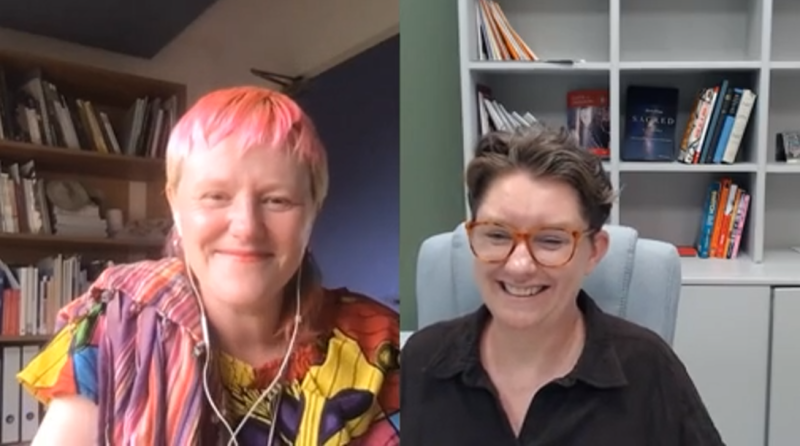
I was recently interviewed by Clare Farrell, one of the founders of the nonviolent direct action climate movement Extinction Rebellion for her current project exploring what an equivalent of Gandhi’s constructive programme might be for these times.
Clare and I have known each other for about four years, since she started Hard Art, the collective of artists, activists, academics, and other leaders who have been gathering around the crises of climate and democracy. So we have talked along the way about the Unitarian tradition and about church and congregation more broadly. But this was the first time we’ve recorded the conversation.
I love the way that certain conversations can bring new thoughts into being.
One in this conversation was about loneliness. When I worked in public health I learned about ‘obesogenic environments’ – where the shapes of our neighbourhoods and patterns of living create the conditions that lead to obesity. That it’s not about willpower or personal choice; those are overridden by the environments that our society has created. Car-centric towns, the way food is produced, priced, and sold, and lack of easy access to healthy activities mean that it’s very easy for people to become obese, however strong their willpower.
This conversation helped me realise the same is true with loneliness. We talked about how loneliness is not just about whether you have friends and social connections, but whether you really have the opportunities for a depth of connection, of being with others in a way that allows a feeling of shared meaning.
Plenty of people can feel lonely even with friends and busy lives if they are missing a level of connection that is life-giving. What became clear to me in the conversation is that loneliness isn’t a personal failing or individual problem to be fixed, but the natural results of the way our society and culture are shaped. We are encouraged to prioritise ourselves, our nuclear families, to choose consumerism over care for the natural world, to fear people who are different to us, or even just those we don’t know. Phone screens offer short term comfort in forms that are known to be addictive, and keep our attention away from those around us. It takes huge effort to counteract all of these societal and cultural forces to choose connection instead. Too often, loneliness wins.
Our congregations are of course places that can address this. They offer something deeply compelling and centred around connection and care. They can counteract the currents of separation that most people are caught in. I have met so many people with busy, full lives, who might not consider themselves ‘lonely’, but who are deeply hungry for depth – a connection more meaningful than the superficial busyness that occupies their attention.
There’s also the kind of loneliness where the lack of connection, meaning and purpose leaves people open to getting their needs met elsewhere – absolutely linked to the rise of racist, misogynistic, divisive movements. As philosopher Hannah Arendt said in her 1951 book ‘The Origins of Totalitarianism’ “Totalitarian domination bases itself on loneliness, on the experience of not belonging to the world at all, which is among the most radical and desperate experiences of man.”
It feels essential to me that those of us offering ways of ‘belonging to the world’ that are based on respecting the dignity and worth of all people must not just leave our doors passively open to all, but actively work to meet people where they are. And to recognise that addressing loneliness not only means creating a welcome, but allowing those who are invited in to express themselves in the space too, to enact their agency in shaping the community of belonging. Depth of connection, agency, and belonging seem closely connected – and our free and inquiring ethos gives a space for this.
I am currently listening to the audiobook of Jon Ronson’s The Castle: Adventures in a World of Unravelling Men, which explores themes of loneliness and despair particularly affecting men. He talks about civic organisations, like community groups and churches, and says “People no longer think those institutions are for them”. This is the context that makes it harder and all the more important for us to show that our congregations are for them – to understand the ways we can invite people in a way that resonates. I’m delighted that our Communications Team, Pamela Welsh and Jessica Ackroyd are hosting monthly Comms Clinics to help congregational leaders with just this.
I’ve been interested to see a current wave of interest in regenerating civic infrastructure. Think-tank Demos are “announcing a Marshall Plan for civic renewal” and their partner Kinship Works recently published their “Meet the Menders” report, asking “If our social fabric is frayed, who’s fixing it?”
It seems very clear to me that our congregations, our ministers, our trustees, our volunteers and staff members are all part of this work of civic renewal. The work to renew our own small congregations is not something we are alone in, but part of a broader trend.
The work couldn’t be more important – even if we don’t always look at what we’re doing through the lens of tackling the loneliness epidemic, preventing the rise of authoritarianism, or mending our social fabric. These big challenges don’t require us to be doing something other than what we have always done – creating welcoming, meaningful opportunities for depth of connection, mutual care, alignment to the things that matter most in life. The work of stewarding congregation is the work that these times are calling for. We don’t need to let go of our roots in order to meet the vast need. But at the same time, the deep need of these times means there is a responsibility to adapt. Our free faith allows us to adapt the way we gather, and demands that we discern a path according to our conscience. It feels essential that the way our congregations gather, the welcome we offer, is guided by the needs of the moment, as well as the roots of our tradition.
The conversation with Clare left me thinking about the importance of congregation-building. In a culture that often pulls people apart, every opportunity to belong becomes significant. Perhaps the work before us is not to become something new, but to offer what we already know how to offer, while finding new ways to reach those who are searching for it.