A Year in the Unitarian World
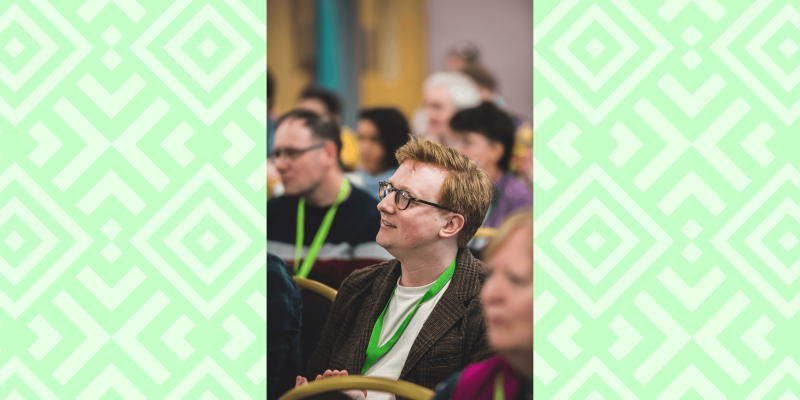
Reflections from Nick Butler-Watts, Innovation Fund Programme Manager
In my first year of studying philosophy and music at university, the module I performed worst in was Philosophy of Religion. Despite this (or perhaps because of this), I was a committed but confused young Christian. This was around the time of the Marriage (Same Sex Couples) Act and, feeling alienated and upset by the mainstream church’s opposition to it, I found myself walking into a Quaker meeting seeking something else and discovered, to my surprise, that silent worship in a non-creedal, mystical, experiential faith suited me very well. I’ve been a Quaker for nearly fifteen years.
I tell you this because it probably explains why, when I arrived in my new job at the General Assembly eighteen months ago, I felt so immediately at home among Unitarians. A faith that can enthusiastically marry people of any gender. That celebrates spiritual seeking, searching, and rational thought. That embraces ritual but holds it loosely. That treats wisdom from other traditions as a banquet rather than a threat. That is full of people sincerely trying to live ethically, ask big questions, and make the world kinder and more just. And (I say this with great affection) one that is partial to a good hymn.
If I’d known about the Unitarian community when I was a student, I may never have become a Quaker. In some parallel universe there is a Unitarian Nick Butler-Watts. Probably not all that different.
If you’re a Unitarian, that might be frustrating to hear. In the dozens of workshops I’ve run over the past year with 130-plus people, I’ve heard a strong and sincere belief that this movement has something important to offer the world; and a frustration that the word “Unitarian” is still so often met with a shrug. At the same time, the movement is ageing and declining, and some congregations are at risk.
The Innovation Fund was established partly in response to this; to create some breathing space, to fund experiments, and to trust that local leaders know what their communities need.
In our first year, we have pledged just over £500,000 to 26 projects across England, Scotland and Wales, most of it matched by others, meaning that nearly £1 million of new funding is flowing into Unitarian life. New mid-week gatherings in Shrewsbury that are consistently bringing in new people. A community hub growing in the Swansea Valley. A children’s magazine club in Lancashire, made by schoolchildren who are getting to know their local Unitarian church. A new worshipping community meeting in central London. An arts festival collaboration in Doncaster. And much more besides.
I won’t pretend the picture is straightforward. Membership and participation in religion is declining, not just among Unitarians, but across virtually all religious communities in Britain, and beyond religious life too. This winding down of church participation is unlikely to be reversed any time soon, if ever. I suspect we are becoming a less institutionally minded society, and less likely to commit to any single community or identity for life. I have spent enough time in the Quaker world to know that liberal faith communities are grappling with the same questions everywhere.
But I have also come to believe that decline is sometimes something more complicated. Perhaps we should view it as more of a transformation, the caterpillar in the cocoon, finding its new form. In ‘Before the Resurrection: Transitions and Endings in Quaker Meetings and Churches’, the Quaker writer Emily Provance makes a useful distinction: resurrection is not the same as resuscitation. We have two options, she says…
“We can fight to preserve [an historical form of Church] unchanged until the moment it dies – or we can recognise that God is doing a new thing, and we can adapt to our new reality […], releasing spiritual energy and resources so that God may use them in new and exciting ways.”
Emily Provance argues that the task for Quakers (and, I think, Unitarians as well) is not to resuscitate the past, unchanged, or to maintain the status quo. Our task is to resurrect it, transformed into a new state of being, carrying the best of our traditions into a future that looks quite different.
That feels appropriate to Unitarianism too. The congregations and leaders I have spent time with this past year are not clinging to the past. They are asking what it means to be a spiritual community in 2026 and beyond. Who needs us, what can we uniquely offer, and how do we make room for the people who haven’t found us yet? These are questions born out of a love for something worth passing on.
The Innovation Fund exists to help answer these questions, one experiment at a time. I hope you’ll read the full year one report, and if you have an idea of your own, I hope you’ll consider applying.
Nick Butler-Watts is the Innovation Programme Manager at the General Assembly.
If your Unitarian community is wrestling with how to move into a positive future, whilst addressing today’s challenges (or you’d like to begin wrestling with that topic!) we can offer a free, facilitated workshop for Unitarian congregations and districts. Please contact Nick Butler-Watts to find out more.
The next Innovation Fund application deadline is 9 November.