We Were Always Radicals – forty years on from Growing Together
A 1985 Unitarian report on feminist theology is 41 years old but reads like it could’ve been written last week. This International Women’s Day, we had a chat with one of the women who wrote it.
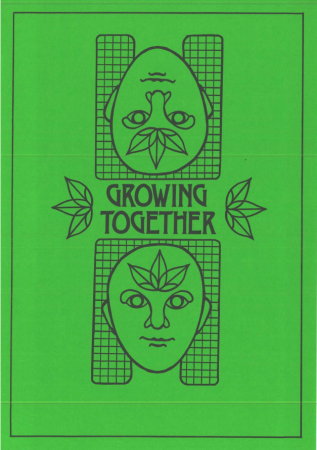
Somewhere in the Unitarian archives there is a green folder. It has two faces on the cover – stylised, androgynous, looking at each other – and the words Growing Together printed in a font that dates it immediately to the mid-1980s. Inside are typed pages full of exercises, essays and discussion guides.
One of the pages is so relevant that it could’ve been written yesterday. The Double-Sided Debate runs in two columns down the page, and it begins like this:
For every woman that is tired of being a weak person when she knows she is strong — there is a man tired of looking strong when he feels vulnerable.
For every woman tired of looking foolish — there is a man tired of people expecting him to know everything.
For every woman tired of being called an emotional female — there is a man tired of the denial of the right to cry and be tender.
It goes on. It covers work, parenthood, money, competition, sexuality, freedom.
“I love that piece,” says Rev Joy Croft, who convened the working party that produced it. “I still do. I still wheel it out in services.”
Growing Together was published in 1985. The year of Live Aid, the miners’ strike, and a world in which the Church of England – and other conservative denominations – did not ordain women. It was the work of a six-person Unitarian working party, made up equally of three women and three men. It had been commissioned by a General Assembly resolution three years earlier. When it was presented to the GA, it was then celebrated, workshopped around the movement. But then, as these things tend to do, it receded.
When you flip through the report now, in 2026, it is mildly disorienting. The pay gap figures have changed but the argument hasn’t. The section on who speaks in meetings, who chairs, who makes the tea — you could hand it to someone today and they might think it had been written about their workplace last Tuesday. The language around gendered images of God, the challenge to examine your own unconscious assumptions, the insistence that feminism is everybody’s issue and not just women’s, combine to have the slightly uncomfortable quality of a mirror. With a few small exceptions, none of it feels like a theology document written forty years ago.
“It shows the best of Unitarianism,” Joy says, “that we can develop our theologies – not to get swallowed up in the times, but to go with the times.”
The women and men who made it were not solemn crusaders. Ann Arthur (now Anne Peart) Joy Croft, Arthur Long, Celia Midgley, Peter Sampson and Len Smith were friends who encouraged each other into ministry, who sang in choirs, who laughed a lot, and who changed the face of feminist theology with their good humour, careful arguments and strong conviction.
This International Women’s Day, we had a chat with Rev Joy Croft, one of the pioneers behind the report.
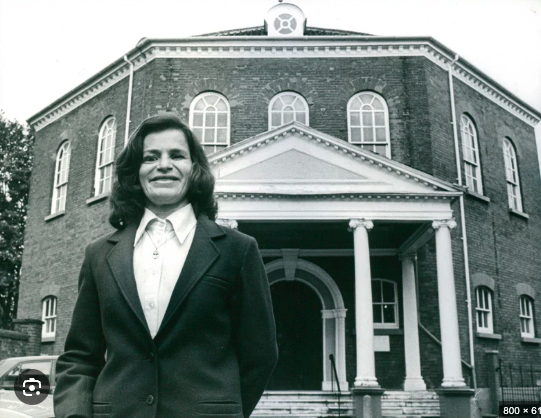
Rev Joy Croft was born in Buffalo, New York, into what she calls “a relaxed Jewish family.” Her father’s biggest concern was education: “he hadn’t been able to have one himself, so money was going into a couple of olive jars, saving up for my brother and me to be able to go to university.” Joy went, and excelled, and was offered a teaching fellowship at the University of Toronto that might have led to a career in English Literature. She came to England for a year to work on her PhD thesis on the poetry of John Keats. Nearly fifty years later, she’s still here.
Joy has had severely impaired eyesight since birth. Four years ago, she lost her remaining sight entirely. This disability, she says, is impossible to separate from everything else, from the determination it required, from the things it turned out not to prevent, and from the perspective it gave her on being told you cannot do something.
“It’s kind of amazing, not just the things that with my determination I managed to do, but the things that it was possible for me to do. Maybe having had really good fortune in the career and the travel and everything else, despite my major disability — maybe it wasn’t quite such a surprise to me to be allowed to do things that women weren’t being allowed to do. Much like become ministers.”
She found Unitarianism the way a lot of people find it: sideways and by accident. Her entry point was through music, following someone else who wanted company to a church choir. It also had a touch of young infatuation – a friend in Buffalo asked her along to the Unitarian church because, she said, the minister was good-looking. The minister was, Joy confirms, very good-looking — “and also really a very good speaker.”
But as many Unitarians know, once she walked in through the door, she was hooked.
“I realised that Unitarianism wasn’t just about answers, however good they were, but about asking questions. And that Unitarian Universalism was so much involved in the movements for racial equality.” She pauses. “That was home.”
She joined the choir, started helping to organise services, and one Sunday offered to lead one herself — built around the poetry of John Donne. “I had a lovely time,” she says. “And a little bell went off inside me.”
She went to see a minister she trusted and told him she had this crazy idea that maybe she wanted to be ordained. He looked at her. “He said: ‘You know, I wondered how long it was going to take you to work that out.'”
He told her she could train at Oxford. Joy, an American academic who had spent years wishing she’d had the chance to study there, said yes immediately. She arrived at Manchester College (now Harris Manchester College) in 1976 and started her ministerial life two years later at Lewisham — “having been lucky enough,” she says drily, “to choose the one denomination that had women ministers.”
The resolution that became Growing Together was proposed at the 1982 General Assembly by Elspeth Vallance. Elspeth was herself a minister, though her situation illustrated something of what the report would go on to examine. “Her ministry was to be supportive of Arthur Vallance, her husband, who was also a minister. He was a big minister, and she was kind of his assistant.” It was Elspeth who saw the moment, named what needed examining, and pushed it through GA. “I’m not sure where she found the idea,” Joy says, “although things were waking up that new wave of feminism was starting, and the movement for the ordination of women in the Church of England was starting.”
The working party that formed around the resolution included Joy, Ann and Celia, along with Peter Sampson, Arthur Long, and Len Smith. The three women were already good friends. They had encouraged each other into ministry. “It was kind of the three of us,” Joy says. “The unholy trinity.” She laughs. “That phrase was not used — that’s just me coming up with it at the moment.”
They met face-to-face, as you did then. They read, they wrote, they deliberated, and after three years they produced a folder. The intention was for it to be used as much as possible, a working document, not a dry report. Joy was explicit about this in the introduction she wrote. “Take the pages out of the folder. Put them in a binder and work through them. Better still, hand them round and use them in whatever order suits you.”
“It was all an adventure,” she says. “The way we designed the cover — those two faces, the importance of relationship. The title we chose. All of those things. And we grew, I think, we grew together through it.”
The working group had big ambitions for the report. It examined the evidence for discrimination against women — the pay gap, domestic violence statistics, psychiatric treatment rates, legal rights that married women still did not fully hold. It looked at the language of faith, making a careful and still-relevant case for why gendered language in worship is not a trivial complaint but a structural one. It explored images of God across scripture, medieval mysticism, and Unitarian history, arguing that female imagery of the divine is not heterodox but ancient and suppressed. And it examined the movement’s own record on women in ministry.
In 1985, roughly sixty percent of Unitarians were women, but only around ten percent of ministers were. This was in a denomination that had appointed its first woman — Gertrud von Petzold, at Leicester — in 1904, decades before most other churches had even begun the conversation. (Caroline Soule was, of course, the first to be ordained). The Unitarians were, by any measure, ahead. The stats are better today – around a third of current active ministers are women, and around 50% of students coming through ministry training today are women.
Joy’s own career was, by any standard, exceptional. First woman president of the Unitarian Ministerial Fellowship. First woman president of the Unitarian Peace Fellowship. Chair of the worship committee. Part of the team that created the British version of Building Your Own Theology. All of it while running full-time ministries, first at Lewisham, then from 1984 at the Octagon in Norwich, one of the most storied Unitarian congregations in the country.
Long before it was common, Joy conducted same-sex blessings. This began in London, through a connection with Keith Gilley at Golders Green — the minister she had admired since her training, her model of what ministry could look like.
The blessings were conducted individually, word getting around on the grapevine. She never told her fellow clergy what she was doing. “It’s only now that you ask me,” she says, “that I think — how did these couples know that I would be sympathetic to what they wanted?”
She moved to Norwich in 1984, let it be known she was available, and waited. The Octagon is now, she notes, a real centre for LGBTQ support and celebration. “Which is amazing. Because when I arrived, the gay and lesbian community kept themselves very much to themselves.”
As we start to prepare for the 2026 General Assembly Annual Meetings, a story Joy tells near the end of the conversation has made us think.
Sometime in the early 1980s, Joy and Celia and Ann had been at the annual meetings, and noticed that although women attended in large numbers, they rarely spoke. The floor was dominated by men moving motions, speaking to reports, holding court. But few women did the same.
“You hardly ever heard a woman’s voice standing up to move a motion, to speak to a report, anything. It was always men.”
They decided to do two things. First, they would sit in the front row together. And they would commit to encouraging each other, visibly and audibly, to stand up and speak.
Secondly, they found out that GA was about to mark an anniversary for Roy Smith, who was General Secretary. “A really lovely guy,” Joy says. “He was really super, and really very encouraging of us women ministers.” And at the right moment, the three of them went up and presented him with a bouquet of flowers.
“Because we felt it shouldn’t just be women who get bouquets on great occasions.
“Those two things — the encouraging of each other to stand up and speak, and the going up and doing what is traditionally done for a woman, for a man whom we liked — those two things really were the shifting things. The General Assembly meetings were never quite the same.”
It’s a perfect example of feminism as a doing word, exactly as it says in Growing Together – feminist theology is something to do, not to read about.
—-
Liz Slade is the Unitarian General Assembly’s first female chief officer. She is also, she notes, about twenty years younger than her predecessor — which means that people are already reading her presence as a statement.
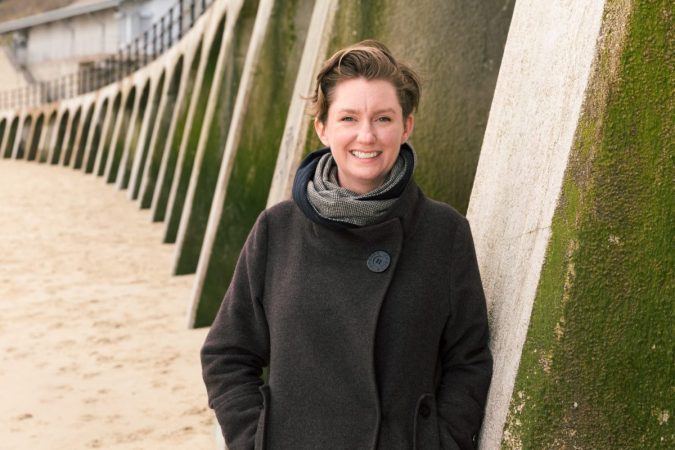
“People already perceive me as making change before I’ve even opened my mouth,” she says. “And that’s been interesting.”
She describes the women who came before her as “battling through the jungle with a machete” — clearing a path for people like her, without necessarily being able to see where it led. She was four or five years old when Growing Together was published.
When she heard that Sarah Mullally had been appointed Archbishop of Canterbury, she felt moved in a way that surprised her. She met Mullally briefly and wanted to express congratulations, gratitude but also concern, for taking up the weight of it.
Joy, when she heard the news, felt something that too. She knows what it is to walk into rooms as the only woman. She knows what it costs.
“I’m remembering going to ecumenical gatherings, often being the only woman there. Having to have the courage to open my mouth.” She thinks about Mullally. “They will see her as creating change before she even opens her mouth. I wonder whether she will get support. Whether she will get credit.” A pause. “I’m delighted it’s happening. It feels like such a step forward.”
The conversation between Joy and Liz has the texture of something that doesn’t happen enough. Not a handover, exactly. More like a comparison of notes. Here is what it looked like then. Here is what it looks like now. Here is what has changed, and here is what — if we’re being honest — hasn’t.
Liz notices that the Growing Together report has exercises about who speaks at meetings, who takes on which roles, where the weight of invisible labour falls. “There are still certain areas that are very male dominated in our movement,” she says. “And in wider society.”
Joy’s hope is straightforward, and it is the same hope that animated the report in the first place. “I would love to sit down with a bunch of younger people and talk about how it was for us. Talk about what we think was our legacy. And ask them — how does that feel? Do you feel it’s been helpful? Are there ways in which you’ve moved away from where we were?” She pauses. “But there doesn’t seem to be the opportunity to do that.”
That gap — between generations who share values but rarely share rooms — is part of what this piece is trying to close.
What Growing Together understood, and what still makes it worth reading four decades on, is that the work is not only out there, in the real world. It is in the language we use for God. It is in who speaks at Unitarian meetings and who stays quiet.
The report is a working document. It is full of exercises and discussion questions and space for groups to do their own thinking. Joy would love to see it used again — at congregations across the movement, anywhere there are people willing to sit in a room together and ask uncomfortable questions about who speaks, who serves, who leads, and why.
“There’s space in church services,” she says, “to really look at the ideas, to think about them, to share ideas, to reflect. Human society is in such a rush always to do things without thinking about the consequences. And there’s space, especially in our church services, to really have that time and depth.” She sounds certain about what comes next. “We almost have a responsibility to keep doing it.”
We’ve come a long way. We’re not there yet.
Growing Together is available to read here
Joy Croft was convener of the Unitarian Working Party on Feminist Theology. The report was presented to General Assembly in 1985.
This piece is based on a conversation with Joy Croft and Liz Slade recorded in February 2026.