Innovation Fund Case Study: Heartspaces
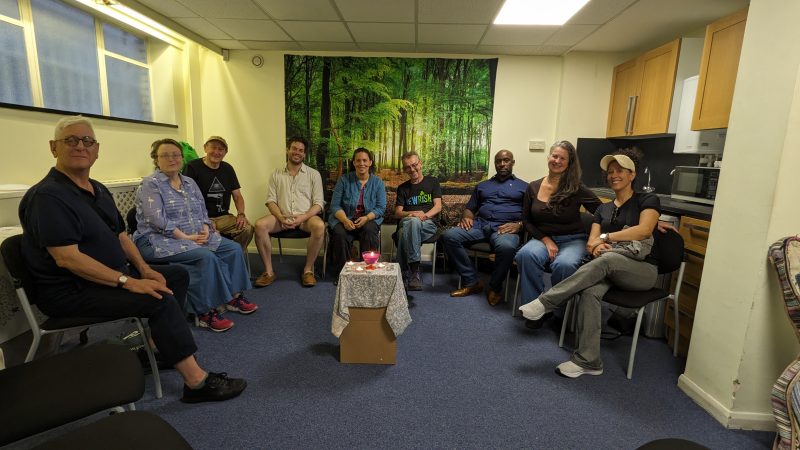
Organiser: Rev. Kate Dean, Rosslyn Hill Unitarian Chapel
Location: Essex Hall, London
Funding awarded: £3,500
Timeframe: September 2025 – June 2026
What was the idea?
Kate Dean, the minister at Rosslyn Hill Chapel in Hampstead, North London, knew that there was an empty space at Essex Hall, the Unitarian office in central London, which was not being used for worship. Kate saw an opportunity to create a new worshipping community in the heart of London. This was something that Kate felt a spiritual calling to do, as part of her ministry.
What did they do?
Heartspaces started in September 2025. They met every Thursday, holding a different event each week, until June 2026. Kate started with a collection of collaborators, mostly Unitarian ministers. Each session was led by two facilitators and typically attracted between 4-8 people.
They rotated through 4 types of events:
Spiritual Jukebox
Everyone brings a song to share. They found that this simple idea can be a rich experience. It is rare for many people to get the chance to listen to a song right the way through, with focus, and offers participants a chance to share music that means something important to them.
Lucky Dip/Heart and Soul
This session began with various people doing different things as a ‘lucky dip’; usually meditation based or something ‘intellectual’. These were less well attended as they didn’t have a consistent message about what to expect. So, they adapted, and this session has developed into a Heart and Soul session instead. Heart and Soul was established by Rev. Jane Blackall at Kensington Unitarians. It is a simple series of practices inspired by ‘Simply Pray’ (4 types of prayer). For more information, visit the Heart and Soul website.
Mystic of the month
This session looks at two mystics, one from East one from West, e.g. Rumi and Julian of Norwich, looking at the mystics’ lives, spiritual practices and writings, followed by a guided meditation to put that into practice. This was popular and typically attracted 8 or so people.
‘Soul Fuel’
A spiritual open mic night. Participants bring a song, story or poem to share, or just enjoy the experience as audience members. Kate would hire a singer song writer to perform in-between other open mic spots. Having a professional musician balances out any uneven quality in-between. Kate often also incorporated a meditation.
What was the grant spent on?
- promotional materials
- provision of a sexton/doorkeeper
- refreshments
- decorative materials for the space
- activity materials for some sessions
What difference did it make?
Kate and the other facilitators found this to be a great opportunity to experiment and innovate with new formats for communal spiritual gatherings. This was an opportunity for people to use their creativity and make use of experience they’ve built up over the years.
Participants from other Unitarian congregations appreciated another way to explore Unitarianism in a convenient location and a chance to meet people from other congregations. One person was on the edge of a congregation and has since become a member, and the ‘Mystic of the Month’ event helped to strengthen their Unitarian identity. The participant had a particular connection to one of the mystics, and was invited to contribute to that session. When people are particularly passionate about a favourite mystic Kate found that this really elevated the session, as it provides an opportunity to share their passion, expertise and interests.
Heartspaces benefits the wider Unitarian ecosystem too. It provides a different setting and service to explore Unitarianism. One person who attends another Unitarian congregation said it was really refreshing to see a wide range of people contribute to the sessions, which was not the case in their home congregation.
What did they learn?
Tension between variety and consistency
One challenge of having different people lead the sessions each week is that this brings a lot of variety but doesn’t provide consistency.
Grow through word of mouth and personal recommendations
Word of mouth has been effective in bringing people to sessions. People bringing friends seems to be the growth opportunity.
Financial sustainability
They haven’t taken a collection or donation at these events. They have had some donations through the website, but the events so far have been offered as free events.
How much involvement do participants want or need?
Various collaborators have had to step back after about 6 months. Kate wants people who attend to be able to contribute, so that it is a shared community, not a service that visitors passively receive. However, she is cautious about putting too much responsibility on newcomers too soon.
‘Do what it says on the tin’
Encourage people to attend by having a clear description of what people can expect.
Vision and leadership
For a project like this to succeed, you need someone to ‘hold a vision’ for the project.
What are the key ingredients for a project like this?
Experienced leaders and committed volunteers, with courage and resilience
Even successful experiments involve some failure and a willingness to keep trying different things. They require leaders who can see past ‘setbacks and failures’ and volunteers who are going to make a commitment for a set period of time.
Proper staging and preparation
Taking care and attention over the little things and really trying hard to provide the opportunity for a spiritual experience. When someone leads a session like this, everyone’s viewing them as the leader and although it’s ok to show you’re not perfect, you do have to present a calm and reassuring, competent presence.
Planning and flexibility
You need to balance having enough preparation so you know roughly how things will pan out, but remain flexible enough that you can change things if they need to go another way.
Hosting well
Remember Mazlow’s hierarchy, and ensure that people’s basic needs are met, i.e. that the space is warm enough, good refreshments, access to toilets.
Music
Music is a powerful way to set a scene, consider having music on entry and exit.
Connect with people
Register people coming in, and follow up afterwards, signpost them to the next thing. What’s the forward journey? What’s the next thing you want them to move on to?
Encourage participation gently
Sitting in a circle is a great way to invite participation; people don’t want to be forced to say something but want to be given space to share if they want to.
Ritual
Include an element of ritual, even if it’s as simple as opening by sounding a chime or a lighting a chalice candle. By ending with a blessing or closing words, you provide a Unitarian ‘container’ for whatever happens in between.
Comfort with small beginnings
Kate’s minimum aim was 4 people. This was achieved 95% of the time! Some sessions only attracted 4 people, but slow and steady growth is preferable to very rapid growth that becomes unmanageable.