July’s Letter from Liz
Each month, we publish a letter from Liz Slade, the chief officer for the General Assembly. This is Liz’s letter for July 2026.
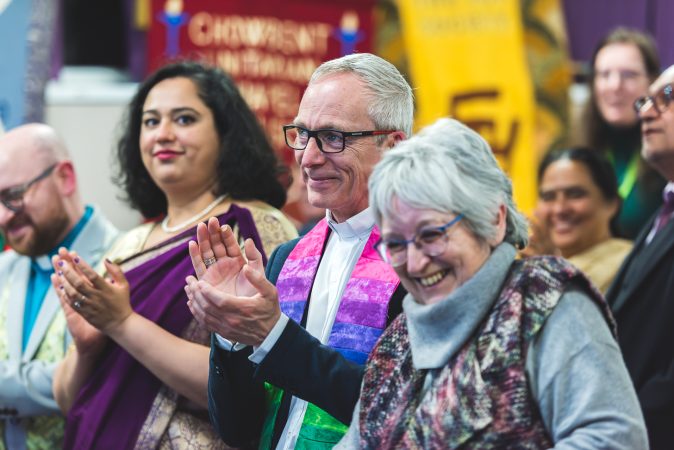
Back in April, nearly 300 Unitarians gathered for our annual meeting at the Hayes Christian Centre in Derbyshire. We had been recommended this venue for a long time, and so were glad to try it out, and the feedback we got from participants was glowing. It felt good to be at a values-led location, to have a chapel and labyrinth on site, and to be in beautiful, cared-for grounds.
So we were deeply disappointed to hear from the Hayes that we’re not welcome to go back.
Their team let us know that their charitable object means they need to prioritise trinitarian Christian groups – that they exist “to promote the Christian faith and to serve Christian groups holding to a trinitarian basis of faith” and as such they’d be unable to accept future booking requests.
I wrote back, clarifying the GA’s own charitable object – “to promote a free and inquiring religion through the worship of God and the celebration of life; the service of humanity and respect for all creation; and the upholding of the liberal Christian tradition” – and that our tradition is explicitly non-credal.
They considered my response but confirmed that their position remains unchanged.
I should be clear that while I am disappointed that we can‘t go back to a venue that (mostly) worked very well for us, I hold no animosity to the Hayes at all. They were very courteous about the whole thing and of course must be bound by their charitable object, as must we.
But it was a reminder of how our tradition puts us outside of many other denominations simply because it is typical for faith groups to be bound by a creed or statement of faith. Our commitment to free religion, to each person in our community to be led by their own conscience, means that we gather around a practice, rather than a belief. There is a category difference between our way of gathering in community and most other denominations in the UK.
It means that it can be hard to find a way to belong to ecumenical groups that do operate with an assumption of creedal faith, such as Churches Together in England, or Inclusive Church.
Our position, of gathering around the commitment to the continued practice of discernment of what is true, wise, and loving, rather than adopting a static statement of faith is not an easy route. It requires continual reflection, learning, listening, and humility. And it means we will be in congregational community with people who see the world very differently to us.
This seems like an essential practice for these times.
Our society can seem very divided, with fracture lines easily appearing between people or groups who hold different opinions and worldviews. We have learnt that social media is designed to maximise engagement, and that outrage keeps us more engaged with and attentive to these advertising platforms than peaceful sharing of difference does.
So if we are practiced in being together across difference, what might our responsibilities be in these fractured times? Can we share what we’ve learned about how to be in community with those who think differently?
And where do we need to practice more deeply ourselves, while the currents of division that we live among flow into our congregations?
I know that even in writing this letter I feel wary of the ways in which the wrong choice of words might cause offence, be misinterpreted, or even cause harm and division when those are the last things on my mind. It would be easier to stay quiet, but as I know this is something that congregations are grappling with themselves, it feels important to name these challenges.
As the EHRC guidelines on the provision of single-sex services become statutory, most congregations will need to have conversations about how they respond (though guidance from Third-Sector Against Transphobia recommends trustees don’t make any rushed decisions). It’s likely there will be differences of opinion, perhaps in unexpected places, and so there is a need to consider how to navigate wisely. A congregation’s commitment to trans inclusion may run counter to their interpretation of the guidelines, and with every person bringing their own lived experience, biases, perspectives to the decision-making, it’s likely that a typical business-like committee meeting with a full agenda won’t be an appropriate setting in which to reach a decision on a sensitive matter.
There are many issues that can be divisive of course, some shared by wider society, some unique to a congregation, like changing the fabric of a church building.
Last week, the Church of England Synod voted to ‘hear’ the Kairos II report from the Palestinian Churches, that I wrote about in my November letter, after being part of a group of church leaders who heard the Archbishop of York speak about it at Lambeth Palace in November. The Synod took care to name that ‘hearing’ didn’t mean agreeing with every word of the report – which is a powerful account written by Palestinian Christians, naming their experience as ‘a time of genocide’, and the violence of illegal settlements.
As I said in November, it feels important to give attention both to the voices from the Palestinian Christians, and to the Jewish voices that condemn the report – and of course to others’ accounts of the devastation and pain that most of us will thankfully not encounter directly. I found the response from Rabbi Jonathan Wittenberg of Masorti Judaism (a socially liberal and theologically traditional movement) helpful.
My conscience tells me that abhorring genocide does not mean I tolerate anti-semitism, or vice versa, but without space for real dialogue it can be easy for people to feel trapped in narrow binaries. It feels essential in honouring the dignity of the lives of all those entangled in the countless years of violence, and the intense devastation of the recent years that we make space to bear witness.
One of the parts of the Kairos report that has stayed with me is the reference to ‘costly solidarity’. I’ll share the whole section here:
“More than ever, now is a time for costly solidarity. By its very nature, true solidarity is costly. It has a price. It is a faith-based stance, a human commitment and a moral responsibility. True solidarity is also the embodiment of our shared humanity and fraternity. Either we live together — or we perish together. Today it is Palestine. Tomorrow it will be other marginalized and oppressed Peoples.”
It seems essential that we practice this solidarity with each other, even knowing that we will fall short time and time again.
When I’d been part of a Unitarian congregation for a year or two, some friends there told me that they’d nearly chosen to leave, over a painful disagreement with someone. But that they’d decided to stay because they saw their commitment to the community as ‘like a marriage’ – you can’t give up at the first sign of difficulty. Working through the challenges is part of what creates the depth that can’t be found elsewhere. It’s flexing the muscle of practising costly solidarity.
As I wrote about in last month’s letter, the opportunity we offer to be together in person, or even in rooted, long-standing community online is something that is rare and precious in Britain today.
And it’s something we need to keep practising. It’s easy for us to assume that others in our community hold the same opinions as us, that they vote the same way, read the same newspapers, live out shared values in the same way. But our central premise of free and inquiring religion – one of the reasons that participation in some church contexts can be difficult for us – reminds us that our own commitment to freedom comes with the commitment to be in community with people whose conscience has led them to different conclusions to our own.
A few years ago, in email dialogue with a few ministers about the ways in which the exclusion from other church groups was playing out in their contexts, rather than feeling despondent or rejected by the barriers to participation that we see from Churches Together or the Hayes venue, I found myself feeling for the question “where is the life in the place in which others are putting us?”.
Rather than wishing to join the groups where churches convene with a credal sense of identity, the times we find ourselves in are showing us the power of our practice of being together across difference, of being continually open to new wisdom, and being disciplined and careful in our discernment and our fellowship with others. It doesn’t mean reverting to a wishy-washy inoffensive beige, or abandoning our conscience – it means investing in relationship in spite of difference, of listening to views we disagree with, of being attuned to hear truth in unlikely places.
So how can we practice this?
I’d be interested in hearing how others deepen their abilities to remain in relationship across difference. But some that I see playing out in our community:
- Hosting and taking part in engagement groups – small groups of dialogue and exploration that build trust and understanding. (Those who aren’t able to host or join one locally could try joining an online Heart and Soul circle.)
- Signing up to the Red Cross ‘Bridging Divides’ podcast and project, “a community of people who put humanity first and choose to show compassion in divided times”.
- Hosting a ‘Soul Deep’ group, following the approach laid out in the book by Revs Kate Dean and Michael Allured
- Taking part in local interfaith initiatives and inviting in local community groups to our spaces, or showing up to their invitations
- Learning from others who are exploring how to be in community across difference, like the Larger Us