March’s Letter from Liz
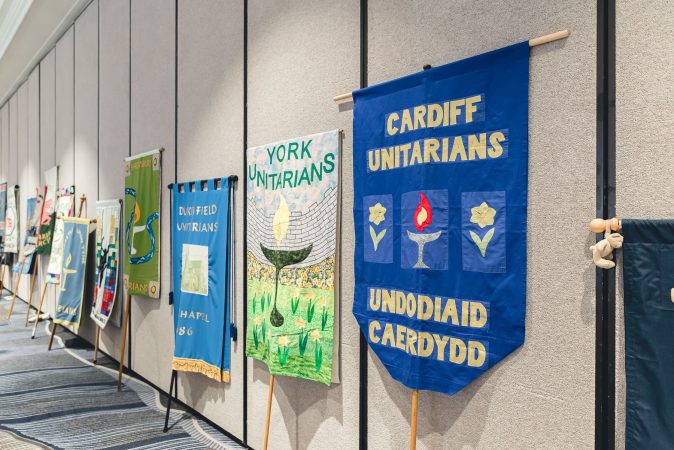
Each month, we publish a letter from Liz Slade, the chief officer for the General Assembly. This is Liz’s letter for March 2026.
As we prepare to gather Unitarians from across the country (and beyond) at our General Assembly annual meeting later this week, the world is reminding us how needed this kind of gathering is.
Ideas of religious tolerance that have become expected in recent decades are being called into question, from the outcry in some quarters to the public Muslim prayers being held in London’s Trafalgar Square for Eid, to the horrific arson attack on ambulances owned by the Jewish community, and the repeated police disruption of a Quaker place of worship. On 5th March, the Metropolitan Police raided the Westminster Quaker Meeting House for the second time in a year, arresting young people who were planning non-violent direct action.
This of course follows a previous raid last March. After a slow and confused start after last year’s raid – it felt like people were slow to comprehend that the Quakers of all people would have their door broken in by the police – there was widespread public outcry, both from religious groups and from many people who despite not being people of faith, saw that a line had been crossed.
This time, the response has been much more muted. I don’t know the reasons why. Perhaps this last year seeing the proscription and then possible de-proscription of Palestine Action as a terrorist organisation and the following arrests of hundreds of peaceful protestors has inured people to the limits of the right to protest. Perhaps it’s that rather than street protest being planned, this year’s meeting was apparently to plan a symbolic act of mass shoplifting. Perhaps the neverending waves of shocking news cycles have left us exhausted. Perhaps, like last time, it will take a little while for the responses to be heard. (Last time, the London Unitarian District passed an emergency motion the following day to show solidarity with the Quakers, despite some people in the district meeting not quite believing that the raid had happened as there hadn’t been anything on the news. It was reported the next day on the front page of the Sunday Times, yet wasn’t reported in Radio 4’s Sunday morning religion programme. It took two weeks for Churches Together in England to issue an open letter to the Met in response.)
Reflecting on that initial raid last year, I felt strongly how the history of dissenting faith groups such as the Quakers and Unitarians was suddenly brought right back to the present. Our original ‘dissent’ was from the codified rules of religion brought in by the Church of England in the 1660s. Those whose faith meant they followed their conscience rather than a man-made rule-book lost their rights and their livelihoods. Even after rules were softened after the ‘Glorious Revolution’ in the 1680s, these non-conformists were not permitted to gather as more than a handful of people, and Unitarians weren’t given full legal rights to worship freely until 1813.
These things until recently were talked about in terms of our courageous forebears, but it’s clear that these patterns are still relevant – those acting in line with their conscience will not be tolerated.
Paul Parker, Recording Clerk for the Quakers said this week: “What’s so outrageous about the way that policing is affecting Quakers at the moment is that these actions that are rooted in love are somehow being criminalised by the state”. I’m sure our forebears felt the same.
On the wall in New Unity’s Newington Green Meeting House, there is a plaque honouring former attendee Mary Wollstonecraft, the 18th century feminist writer, that includes her line “All the sacred rights of humanity are violated by insisting on blind obedience”.
I contemplated it on my visit there last Sunday (Mothering Sunday being traditionally a time for visiting one’s ‘mother church’; now that I live an hour’s drive from New Unity rather than a ten minute walk, I sadly don’t get there very often). After the service, I walked up Barbauld Road, named after another phenomenal woman from that congregation, the writer Anna Laetitia Barbauld, and then turned the corner to see that a local pub was being refurbished to reopen as the ‘Mary Wollstonecraft Freehouse’.
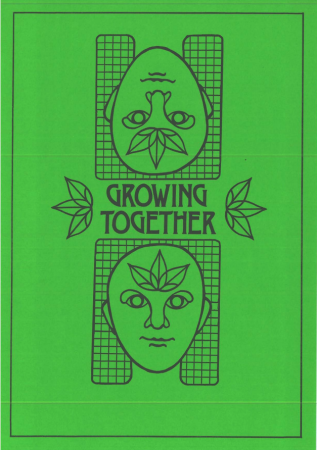
It gave me hope and perspective that these free-thinking women would be honoured in the physical infrastructure of their neighbourhood 250 years after they were here themselves. Time is a stretchy thing. Our conversation for International Women’s Day with Rev Joy Croft, reflecting on Growing Together, a report on feminist theology that she and five colleagues created in 1985 showed just how little has changed in those forty years – while life is simultaneously wildly different. I suspect if Wollstonecraft and Barbauld visited us today they would feel much the same. Rights they didn’t dream of are commonplace (at least in Britain), yet we still live among entrenched patriarchal norms, as the news cycles make all too clear.
If current affairs tell us anything, it’s that we can’t assume a continual linear path of progress. Rights that are won can also be lost.
The dissent of the 1660s of refusing to conform to new religious rules may not seem very relevant to most people’s lives today. People in Britain have freedom to express their faith, and the Church of England that our forebears were dissenting from has much less power than it did then, and only a tiny proportion of the population are active participants in Anglican worship. But the principle of standing up for what our conscience dictates to be truthful and loving can still land us in hot water.
Two centuries ago, when Unitarians were given full civil rights, there was a move towards the mainstream. Hidden simple meeting houses were replaced with huge, visible, confident neogothic churches. Unitarians held office and shaped Victorian Britain from seats of power, not just from the edges. 20th Century Unitarians saw their values of freedom, reason and tolerance become so mainstream that they hardly differentiated us from the increasingly secular culture. As we head into the mid 21st century, it may be that our edge-dwelling roots become more important again.
Certainly, the two motions that have arisen from our membership this year – one on making public statements, and one on the right to protest – suggest that Unitarians are feeling this need to stand up and speak out rather than tolerate the “sacred rights of humanity” being “violated by blind obedience”.
As we gather at our Unitarian annual meeting, regrouping as a family of clergy, congregations, and societies, we are ourselves in a time of significant change as we adapt to the shifting needs and expectations of a free and inquiring faith. It’s clear that the role we can play in offering a space of community that stands up for love, truth, and freedom of conscience is deeply important to this moment.