Marking LGBT+ History Month
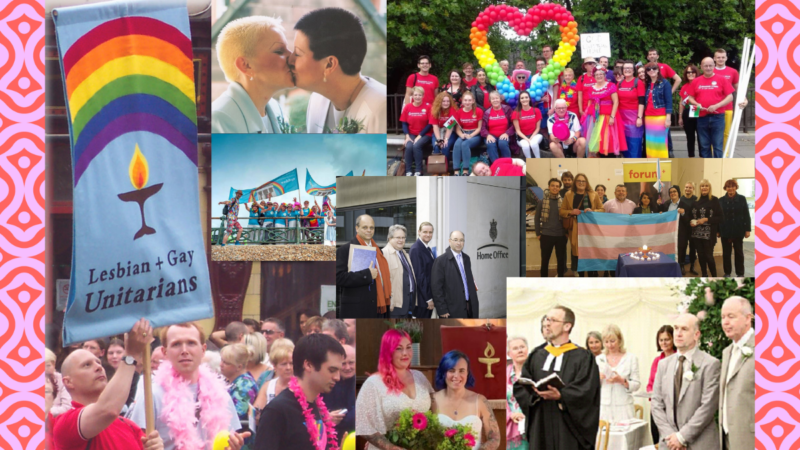
Unitarians are marking LGBT+ History Month with special services and events throughout February. Unitarians have a long history of campaigning for lesbian, gay, bisexual, transgender and queer people’s equality and inclusion and have the largest number of churches offering same-sex marriage of any denomination in the UK. Below you can find a timeline of Unitarian LGBT+ history and useful resources.
Many of our congregations are currently holding special events under the umbrella ‘A Celebration Of Love’ between 25 January and 14 February, the respective days of two patron saints of love, St. Dwynwen and St. Valentine. As part of this, one Welsh Unitarian minister appeared on Welsh television with his husband to talk about LGBT+ inclusion in the church.
UNITARIAN LGBT+ RESOURCES
Find out more about same-sex marriage ceremonies in Unitarian churches, chapels and meeting houses.
- Download an LGBT+ Pride Chalice Logo, created by Rosslyn Hill Chapel Unitarians, Hampstead
- Video: Unitarians at London Pride (2016)
- ‘Where We Stand’ LGBT+ Leaflet (2010)
- Download ‘We are proud to be an LGBT+ inclusive church’ social media images for Facebook, Instagram and Twitter.
UNITARIAN LGBT+ TIMELINE
Some important dates in the story of LGBT+ inclusion in the General Assembly of Unitarian and Free Christian Churches:
- 1963 – The General Assembly passed a resolution urging a more liberal approach to homosexuality.
- 1964 – The booklet “Man, Woman and Child” by the Social Service Department of the General Assembly called for implementation of the Wolfenden Report‘s recommendations on homosexual law reform (which did not happen until 1967 in England and Wales).
- 1970 – One of the first grassroots church initiatives in the UK supporting LGBT+ people ‘Integroup’, led by Dudley Cave, was set up at Lewisham Unitarian Church by Rev. Dr. Tony Cross, and also at Golders Green Unitarian Church by Rev. Keith Gilley, who began conducting “gay union” ceremonies in the 1970s. Carol Steele has recently written that Rev Keith Gilley was the first clergyman to accept her as a woman in “Trans Britain: Our Journey from the Shadows”. From ‘Integroup’ emerged the Lesbian and Gay Switchboard and the Lesbian and Gay Bereavement Project.
- 1972 – The Unitarian Young People’s League held an autumn convention at Great Hucklow focussing on homosexuality and agreed to raise the subject at the next General Assembly.
- 1973 – The General Assembly passed a resolution on ‘Homosexuality’ after considerable discussion, setting up a ‘study group’ to examine the question. Guest speakers were Anthony Grey (Trustee of the Albany Trust and Chairman of the National Federation of Homophile Organisations) and Stephen Etherington (Campaign for Homosexual Equality and the Gay Liberation Front). The same year, Rev G.L. Pruce, in a lecture at Manchester College, Oxford, on “Love, Marriage and the Family”, convened by the General Assembly’s Department of Social Responsibity, called for homosexual relationships to be given legal and social sanction, like heterosexual marriage.
- 1974 – The General Assembly was presented with a Report on Homosexuality.
- 1975 – Gay Sweatshop performed the play Mister X in Golders Green Unitarian Church.
- 1977 – The General Assembly passed a resolution on ‘Open Ministry – Gay Rights’ which confirmed Unitarian ministry was open to all regardless of sex, race, colour or sexual orientation. The same year, a second resolution on ‘Homosexuality’ declared: “abhorrence of discrimination solely on the basis of sexual orientation” and pledged to “to bring liberalising pressures to bear on those public bodies where discrimination against the homosexual still persists”.
- 1984 – The General Assembly passed a resolution on ‘Homosexuality’ in favour of the age of consent being the same for homosexuals and heterosexuals.
- 1993 – “Celebrating Life: a book of special services in the Unitarian and Free Christian tradition” included a section on the blessing of a same-sex partnership. It was recognised with an Institute of Social Inventions Award.
- 2000 – The General Assembly passed a resolution on ‘Sexual Equality’ against discrimination on the grounds of sexuality, and called on the government to outlaw such discrimination, and a second resolution calling for repeal of the infamous Section 28 legislation that prohibited the “promotion of homosexuality” by local authorities.
- 2008 – The General Assembly passed a resolution calling for same-sex civil partnerships in church.
- 2012 – Cross Street Unitarian Church (Manchester) became the first place of worship in the UK to register for civil partnerships and Ullet Road Unitarian Church (Liverpool) conducted the first religious same-sex civil partnership in the UK.
- 2012 – The General Assembly passed a resolution calling for same-sex marriage in church and campaigned for a change in the law, along with allies including Liberal Judaism, Reform Judaism, and the Quakers.
- 2013 – The Marriage (Same Sex Couples) Bill was passed, allowing for same-sex marriages in churches and other places of worship. The change in the law was celebrated by the Unitarians any Unitarian churches immediately began the process of registering to offer same-sex marriage ceremonies.
- 2016 – Rev. Stephen Lingwood, as bisexual queer man, wrote on “Navigating relationships and sexuality” in the Lindsey Press publication “Living with Integrity: Unitarian Values and Beliefs in Practice”.
If you have more information, photos, memories or resources to share about Unitarian LGBT+ History, please get in touch.